 |
|
You are here: CBM Wiki>Public Web>PublicMuon (2020-07-01, ParthaPratimBhaduri)Edit Attach
Mini-MuCh
Mini-much is a sub system of the mini-cbm set up. The sectors of the CBM MUon CHamber system (MUCH) are made of trapezoidal shaped GEM modules. Three of those trapezoidal shaped GEM modules with a spacing of 10 - 20 cm will form the mMUCH subsystem providing additional tracking points for track reconstruction. While the actual CBM MUCH design comprises a spacing of any two consecutive layers of about 10 cm a larger distance between the GEM modules for the mCBM test-setup seems to be reasonable to improve the track reconstruction. A detailed simulation in this regard may guide us towards optimum choice of these gaps. Each GEM module will be mounted on a 10 mm Aluminum plate as depicted in the following figure. A photograph of a real-size M1-type module used during the CERN SPS beam test in 2016 is also shown. The updated version M2 which is marginally larger in size will be used for mCBM. The detector will be positioned on one side of the Al-plate while the readout FEBs will be fixed on the other side providing a proper thermal contact to the Al-plate. A controlled water-flow either through grooved channels or through 6 mm Al-pipes winding inside the Al-plates will provide the cooling for the FEBs. Each module will be read-out by 18 FEBs, i.e. about 2200 channels. For the GEM modules single-mask triple GEM foils will be used having 24 segments each. Each of these segments will be powered by a resistive chain via an opto-coupler interface. Modules based on this approach are currently under fabrication for lab tests. These will also be used in the forthcoming beam test at CERN-SPS in November 2017.
 Figure 7: Left side - the present CbmRoot geometry of three GEM modules forming the mMUCH subsystem. Right side - photograph of a trapezoidal module mounted on a Aluminum plate used during the CERN-SPS test in 2016.

| I | Attachment | Action | Size | Date | Who | Comment |
|---|---|---|---|---|---|---|
 jpg jpg |
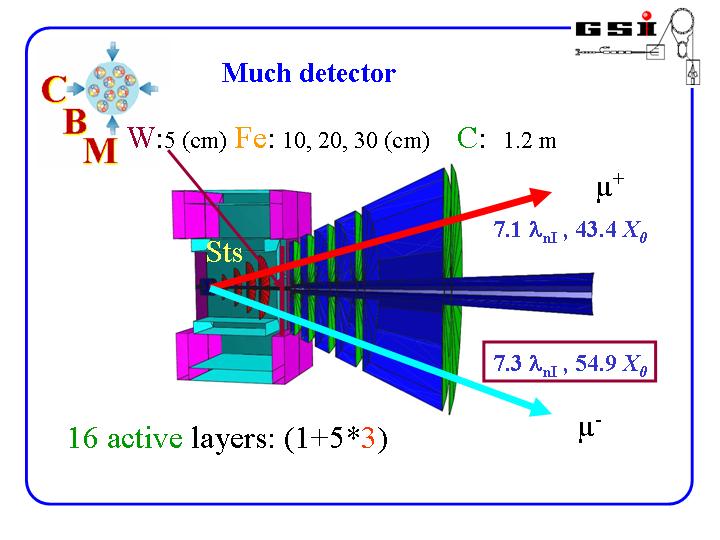
CBM_MuonW.jpg | manage | 47 K | 2006-11-29 - 16:55 | IouriVassiliev | CBM Much detector |
Edit | Attach | Print version | History: r10 < r9 < r8 < r7 | Backlinks | View wiki text | Edit wiki text | More topic actions
Topic revision: r10 - 2020-07-01, ParthaPratimBhaduri


 Copyright © by the contributing authors. All material on this collaboration platform is the property of the contributing authors.
 Ideas, requests, problems regarding CBM Wiki? Send feedback
Imprint (in German)
Privacy Policy (in German)